
3. Make a treatment decision

3.2 Bisphosphonates for Osteoporosis

Advice

Osteoporosis is a health condition that weakens bones, making them fragile and more likely to break. It develops slowly over several years and is often only diagnosed when a fall or sudden impact causes a bone to break (fracture).

The most common injuries in people with osteoporosis are:

However, breaks can also happen in other bones, such as in the arm or pelvis. Sometimes a cough or sneeze can cause a broken rib or the partial collapse of one of the bones of the spine.

Osteoporosis is not usually painful until a bone is broken, but broken bones in the spine are a common cause of long-term pain.

Although a broken bone is often the first sign of osteoporosis, some older people develop the characteristic stooped (bent forward) posture. It happens when the bones in the spine have broken, making it difficult to support the weight of the body.

Osteoporosis can be treated with bone strengthening medicines.

You can use this section to help you understand how you can treat your osteoporosis and reduce the chances of having a fracture.

You can read about the medication bisphosphonates and let us know if you would like us to prescribe this for you.

Please only use this section if you have been signposted here by your healthcare professional.

Credits

Information displayed on these pages has been sourced and adapted from the following


Quality assurance

Our clinical team periodically review the information on these pages to make sure that we are providing you with the most up to date medical information and services.

  • Last review 28.04.2026
  • Next review due 28.04.2027

Please complete the following form

Frequently Asked Questions

What is osteoporosis?

The word osteoporosis means spongy (porous) bone.
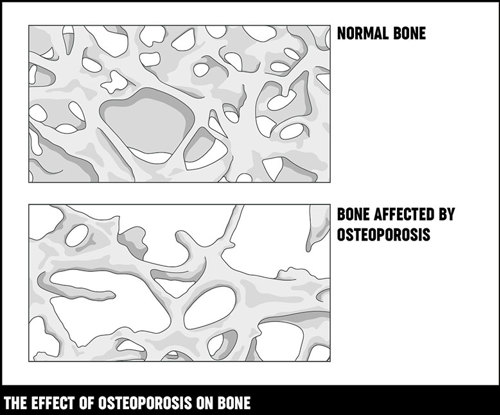
Bone is made up of minerals, mainly calcium salts, bound together by strong collagen fibres. Our bones have a thick, hard outer shell (called cortical or compact bone) which is easily seen on x-rays. Inside this, there’s a softer, spongy mesh of bone (trabecular bone) which has a honeycomb-like structure.

Bone is a living, active tissue that’s constantly renewing itself. Old bone tissue is broken down by cells called osteoclasts and is replaced by new bone material produced by cells called osteoblasts.

The balance between the breakdown of old bone and the formation of new bone changes at different stages of our lives.

  • In childhood and adolescence, new bone is formed very quickly. This allows our bones to grow bigger and stronger (denser). Bone density reaches its peak by our mid- to late-20s.
  • After this, new bone is produced at about the same rate as older bone is broken down. This means that the adult skeleton is completely renewed over a period of 7–10 years.
  • Eventually, from the age of about 40, bone starts to be broken down more quickly than it’s replaced, so our bones slowly begin to lose their density.

We all have some degree of bone loss as we get older, but the term osteoporosis is used only when the bones become quite fragile. When bone is affected by osteoporosis, the holes in the honeycomb structure become larger and the overall density is lower, which is why the bone is more likely to fracture.
Who gets osteoporosis?

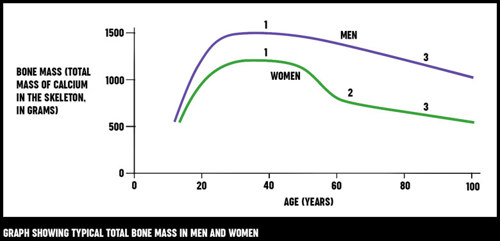
Osteoporosis is common in the UK, and the risk increases with age. Anyone can get osteoporosis but women are about four times more likely than men to develop it. There are two main reasons for this:

  • The process of bone loss speeds up for several years after the menopause, when the ovaries stop producing the female sex hormone oestrogen.
  • Men generally reach a higher level of bone density before the process of bone loss begins. Bone loss still occurs in men but it has to be more severe before osteoporosis occurs.

A graph showing typical total bone mass in men and woman across different age ranges.

A number of other risk factors can increase your chances of developing osteoporosis.

What are the risk factors for osteoporosis?

Steroids (especially if taken by mouth) – Steroids (corticosteroids) are used to treat a number of inflammatory conditions including rheumatoid arthritis. They can affect the production of bone by reducing the amount of calcium absorbed from the gut and increasing calcium loss through the kidneys. If you’re likely to need steroids, such as prednisolone, for more than 3 months your doctor will probably suggest calcium and vitamin D tablets, and sometimes other medications, to help prevent osteoporosis.

Read more about steroid tablets.

Lack of oestrogen in the body – If you have an early menopause (before the age of 45) or a hysterectomy where one or both ovaries are removed, this increases your risk of developing osteoporosis. This is because they cause your body’s oestrogen production to reduce dramatically, so the process of bone loss will speed up. Removal of the ovaries only (ovariectomy or oophorectomy) is quite rare but is also linked with an increased risk of osteoporosis.

Lack of weight-bearing exercise – Exercise encourages bone development, and lack of exercise means you’ll be more at risk of losing calcium from the bones and so developing osteoporosis. Muscle and bone health are linked so it’s also important to keep up your muscle strength, which will also reduce your risk of falling.

However, women who exercise so much that their periods stop are also at a higher risk because their oestrogen levels will be reduced.

Poor diet – If your diet doesn’t include enough calcium or vitamin D, or if you’re very underweight, you’ll be at greater risk of osteoporosis.

Heavy smoking – Tobacco is directly toxic to bones. In women it lowers the oestrogen level and may cause early menopause. In men, smoking lowers testosterone activity and this can also weaken the bones.

Heavy drinking – Drinking a lot of alcohol reduces the body’s ability to make bone. It also increases the risk of breaking a bone as a result of a fall.

Family history – Osteoporosis does run in families, probably because there are inherited factors that affect bone development. If a close relative has suffered a fracture linked to osteoporosis then your own risk of a fracture is likely to be greater than normal. We don’t yet know if a particular genetic defect causes osteoporosis, although we do know that people with a very rare genetic disorder called osteogenesis imperfecta are more likely to suffer fractures.

Other factors that may affect your risk include:

  • ethnicity
  • low body weight
  • previous fractures
  • medical conditions, such as coeliac disease (or sometimes treatments) that affect the absorption of food.

Will exercise help me?

Any exercise where the bones are made to carry the weight of the body, such as walking, can speed up the process of new bone growing.

The more weight-bearing exercise you do from a young age, the more this will reduce the risk of getting osteoporosis.

If you do have osteoporosis, doing weight-bearing exercise will minimise bone loss and strengthen muscles.

However, all forms of exercise will help to improve co-ordination and keep up muscle strength. This is important because muscles can also become weaker as we get older, and this is a risk factor for falling and therefore for fractures.

T’ai Chi can be very effective in reducing the risk of falls. Doing T’ai Chi regularly will strengthen muscles in the upper body, lower body and the core. It also improves balance.

Walking is a good exercise to improve bone strength and it is also good for keeping thigh and hip muscles strong, which is important to help people have good balance and prevent falls.

High-impact exercise such as skipping, aerobics, weight-training, running, jogging and tennis are thought to be useful for the prevention of osteoporosis. These exercises might not all be suitable if you have osteoporosis.

For more support, motivation and advice talk to your doctor, a physiotherapist or a personal trainer at a gym about your condition and the best exercise for you.

How can improve my diet to help?

Calcium

The best sources of calcium are:

  • dairy products such as milk, cheese and yogurt (low-fat ones are best)
  • calcium-enriched types of milk made from soya, rice or oats
  • fish that are eaten with the bones, such as tinned sardines.

Other sources of calcium include:

  • leafy green vegetables such as cabbage, kale, broccoli, watercress
  • beans and chick peas
  • some nuts, seeds and dried fruits.

If you don’t eat many dairy products or calcium-enriched substitutes, then you may need a calcium supplement.

What about vitamin D?

Vitamin D is needed for the body to absorb and process calcium and there’s some evidence that arthritis progresses more quickly in people who don’t have enough vitamin D.

Vitamin D is sometimes called the ‘sunshine vitamin’ because it’s produced by the body when the skin is exposed to sunlight. A slight lack (deficiency) of vitamin D is quite common in the UK in winter.

The National Institute for Health and Clinical Excellence (NICE) has issued guidance on safe sunlight exposure which aims to balance the benefits of vitamin D against the risks of skin cancer from too much exposure to sunlight.

Vitamin D can also be obtained from some foods, especially from oily fish, or from supplements such as fish liver oil. However, it’s important not to take too much fish liver oil.

Because we don’t get enough sunshine all year round in the UK, and because it’s difficult to guarantee getting enough vitamin D from what we eat, Public Health England recommends that everyone should take a 10 microgram supplement of vitamin D every day during the autumn and winter.

People in certain groups at risk of not having enough exposure to sunlight, or whose skin is not able to absorb enough vitamin D from the level of sunshine in the UK, are encouraged to take a daily supplement of 10 micrograms all year round.

For many people, calcium and vitamin D supplements are prescribed together with other osteoporosis treatments.

What are bisphosphonates?

Bisphosphonates are a group of drugs that work by slowing bone loss. They reduce the risk of hip and spine fractures. Bone renewal is a slow process, but in many people an increase in bone density can be measured over five years of treatment

How do bisphosphonates work?

Bisphosphonates can be used to reduce the risk of hip and spine fractures in osteoporosis. They may also be used, at different doses, to treat Paget’s disease of bone.

Bisphosphonates can be taken by mouth (orally), through a drip (intravenous infusion) or by injection.

It’s important to continue treatment as your doctor advises – even though you won’t be able to feel whether it’s working.

Because longer-term treatment can sometimes have side-effects your doctor may suggest a break from treatment after 3–5 years. The benefits of treatment last a long time though, so there’s no need to worry that these will be lost if your doctor does suggest a ‘treatment holiday’.

How do I take bisphosphonates?

Oral bisphosphonates tend to be poorly absorbed by the body and can cause irritation of the gullet (heartburn), so it’s very important that you carefully follow the instructions for taking your medication:

  • Take it on an empty stomach with a glass or two of plain tap water. Other drinks may prevent the drug being properly absorbed by the body.
  • You shouldn’t eat anything or drink anything other than tap water, or take any other medication or supplements for at least 30 minutes afterwards (45 minutes for Bonviva). This is to help ensure the medication is effectively absorbed.
  • You’ll need to stay upright (sitting, standing or walking) for up to an hour afterwards to prevent the medication flowing back from your stomach and causing heartburn.
  • You shouldn’t lie down after taking bisphosphonates until after you’ve eaten.

What are the common side effects?

Bisphosphonates are generally well tolerated. The risk of digestive problems with oral preparations is very much reduced if you carefully follow the instructions that come with your medicine.

Less common side-effects include:

  • itchy rashes or photosensitivity (rash on exposure to sunlight)
  • a sore mouth
  • flu-like symptoms (more common with intravenous treatment)
  • bone pain (more common with intravenous treatments)
  • muscle pain
  • headaches.

You should report any side-effects to your doctor or rheumatology nurse and the drug may be stopped if necessary.

Are there any potentially serious side effects?

There are three very rare side-effects that it is important to know about

  • Osteonecrosis of the jaw is a condition where healing is incomplete following an invasive dental procedure. An area of bone is exposed through the gum and a small amount of bone dies. This condition is more common if you have cancer, are having chemotherapy or you have severe, recurrent dental infections and are having dental treatment.
  • It’s been suggested that there’s a possible, though small, increase in the risk of cancer of the oesophagus (gullet) in people taking bisphosphonates by mouth for more than 3–5 years. However, the evidence is mixed and in most situations, the benefits of treatment are greater than any potential risk.
  • Some people taking bisphosphonates have developed painful, partial or complete fractures in the upper, outer region of the thigh bone (femur) below the hip. Partial fractures are usually confirmed by a special diagnostic scan. The risk appears to increase the longer you’ve been taking these drugs, and may be greater if you’re also having steroid treatment or have diabetes. However, it’s still extremely rare

Can I drink alcohol?

Alcohol is unlikely to interact with bisphosphonates. However, heavy drinking is a risk factor for osteoporosis and for having falls so it’s recommended that you drink alcohol only in moderation.

Does the treatment affect me breast feeding or if I am pregnant?

Osteoporosis usually affects older people, so there’s only limited evidence concerning the use of bisphosphonates by women who are pregnant or breastfeeding.

Bisphosphonates can cross the placenta to the unborn baby and can also pass into breast milk in small amounts. There’s no clear evidence that this is harmful to the child. However, as a precaution, it’s recommended that treatment with bisphosphonates is stopped at least three months before trying for a baby and while breastfeeding.

Why is it important that I see a dentist?

During bisphosphonate therapy you should maintain good oral hygiene and have regular dental check-ups. If you’re expecting to have dental work it’s usually best if this can be completed before starting bisphosphonates. However, it may not be necessary to stop your bisphosphonates if you do need dental treatment later on. If in doubt, check with your doctor.